Can AI Forecast Short-Term Price Moves? Testing the Models
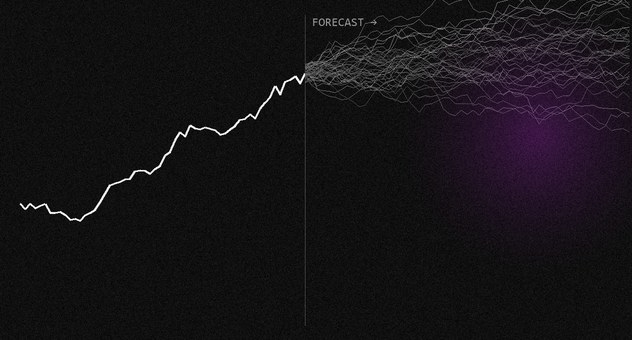
Short-term price moves are among the hardest things in finance to forecast. Prices are noisy, competition is intense, and any pattern that works tends to fade as others find it. So can AI do it? Sometimes, a little — and proving even that takes far more discipline than building the model.
Why short-term forecasting is so hard
Over minutes, hours or days, most price movement is noise. The genuine, predictable part is small and constantly changing. Machine-learning models are extremely good at finding patterns — which is exactly the danger: given enough data, they will find patterns in noise that will never repeat.
The real work is therefore not in building a model that fits the past. It is in proving that what the model learned is likely to hold in the future.
The traps that make bad models look good
- Overfitting — a model that memorises history rather than learning from it. It looks brilliant in testing and fails in live markets.
- Look-ahead bias — accidentally using information that was not available at the time, such as revised data or a closing price before the close.
- Survivorship bias — testing only on companies that still exist today, quietly removing the failures.
- Ignoring costs — a forecast that is right on paper can still lose money after spreads, fees and the impact of trading.
A backtest is not evidence that a model works. It is evidence that it did not obviously fail.
How we test a model before it goes live
Every model at Foxiton goes through the same sequence before it is trusted:
- Point-in-time data — the model only ever sees information exactly as it existed at each moment.
- Walk-forward testing — models are trained on one period and tested on the next, repeatedly, rather than on one convenient split.
- Realistic costs — every simulated trade includes estimated costs and limits on how much can be traded.
- Out-of-sample checks — performance is measured on data the model never saw while it was being built.
- Live monitoring — once deployed, forecasts are compared with what actually happened, and models that drift are retired.
Forecasts are probabilities, not certainties
A good forecasting model does not say “this stock will rise tomorrow”. It says something closer to “given everything we can measure, the odds slightly favour a rise, with this much uncertainty”. Those small edges are only useful when they are measured honestly, combined carefully and managed with strict attention to risk.
So — can AI forecast short-term price moves? Not perfectly, and never with certainty. But with disciplined testing, it can find small, measurable edges in the noise. That discipline is the research.
Key takeaways
Short-term prices are mostly noise; the predictable part is small and changes over time.
Overfitting, look-ahead bias, survivorship bias and trading costs make many models look better than they are.
Point-in-time data, walk-forward tests and live monitoring are what separate evidence from luck.
THIS ARTICLE IS FOR INFORMATION AND EDUCATION ONLY. IT IS NOT INVESTMENT ADVICE OR A RECOMMENDATION TO BUY OR SELL ANY SECURITY.
NEXT ARTICLEHow Language Models Read Earnings Calls and Filings